



“Study in Poland” at education fair in Georgia: Tbilisi – October, 6-7

"Study in Poland" program is encouraging young Georgians to study in Poland! We are returning to the Georgian market to rebuild and strengthen the presence of Polish universities in this country and to encourage young Georgians to study in Poland.
Information for refugees from Ukraine NB – find useful links and contacts below the text

Border crossing
If you are fleeing the Russian military aggression against Ukraine, you will be admitted to Poland.
If you do not have a place of stay in Poland, go to the nearest reception point.
At the reception point: you will receive more detailed information about your stay in Poland, we will provide you with temporary accommodation in Poland, you will receive a hot meal, drink, basic medical assistance and a place to rest.
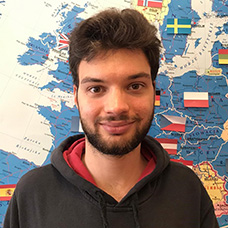
IOANNIS FANARIOTIS
Greece
Opole University of Technology
I have been studying at the Opole University of Technology for 5 months and I can’t describe my experience with words. The university is a great place to study, the dorms are comfy and I met hundreds of people from all over the world. I visited a lot of Polish cities. I highly recommend visiting Poland and Opole for Erasmus+ studies. I am looking forward to visiting Opole again

Artem Petchenko
Russia
I’ve chosen Gdansk University because I didn’t want to go where everyone went, to the capital, to Krakow or Poznan. Besides, Gdansk University is very modern. Before taking up the decision, I visited several cities and finally found myself in Tricity on May holidays. I fell in love with Gdansk at first sight, especially in the sea, and decided that I had to get back there.

Fabiana Ambroa Ibarruri
Uruguay
I compared the study programs in the field of International Law at various universities. I had a choice to study in Sweden or in the Netherlands but I decided to enroll at Adam Mickiewicz University in Poznań, Poland. AMU convinced me with comprehensive academic offer and advanced research opportunities. Before departure I was not quite sure whether I find my way around in a foreign country.
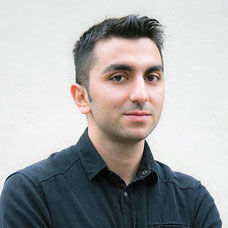
Mertcan Saral
Turkey
Gdansk University of Technology
Gdańsk University of Technology gives practical experience and engineer design program knowledge which a new graduate engineer always needs when starts career. Moreover, GUT provides you a chance to gain much more experience in the Europe with Erasmus+ Programme. Gdańsk is a city that you will never forget, you can take historical trips and have great time at the sandy beach.

Ghanshyambhai Khatri
India
Well, mainly due to academic reasons – First, I was attracted by the research in few-body physics, experimentally (group of prof St. Kistryn) & theoretically (group of prof H. Witala), at Jagiellonian University. Second, in childhood I used to read/hear stories about Copernicus who also studied at JU. Moreover, I found Krakow as one of the most beautiful city in Europe. . So I applied for PhD in MPD project (Foundation for Polish Science) coordinated by prof Pawel Moskal and I was selected through competition.

Katsiaryna Kandybovich
Belarus
I am from Minsk and I study IT at Lodz University of Technology. I have nothing but positive things to say about my university. My time here has been enjoyable and worthwhile. I've met the most amazing people not just across the country, but from around the world.The administration is always helpful and my experience with the staff has been great. They are willing to help you achieve whatever you want! I've never run into any type of trouble.
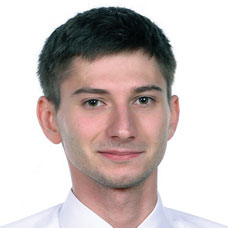
Oleksii Fedorenko
Ukraine
Poznan University of Technology
I came to Poland for master degree studies and fortunately I got admission to Poznan University of Technology. Being a telecommunication engineer I've chosen ICT (Information and Communication Technologies) program, where all courses are conducted in English. Now I am finishing the studies and preparing for diploma exam. I can definietly recommend Poznan University of Technology for everybody who wants to get quality technical education.

Liya Su
China
Studying at the University of Lodz is an opportunity to meet people representing a variety of cultures from all over the world. The University of Lodz gives me a chance to get education on a high quality level with low costs of studying. The city of Lodz is a typical “academic city” where I found great living environment. You can't get bored here of feel lonely especially at the weekends when many different events take place in the city, during which people can get to know each other better.

Aleksandra Kishko
Belarus
Warsaw University of Life Sciences – SGGW
I am a second-year student. I study tourism and recreation at the Warsaw University of Life Sciences - SGGW. I have Polish roots, which is why I decided to study in the country of my ancestors. I had been thinking about the university that I wanted to chose for some time and decided that WULS-SGGW would be the best option. I have heard many positive opinions about it from friends. After graduation, one is prepared to start working and to take up further challenges. Studying at WULS-SGGW is a mere pleasure.

Angelo Giuriano
Italy
Wroclaw University of Technology
Before I chose the Wrocław University of Technology I already knew about the great hospitality that Polish people could give you, but when I just arrived at WrUT I have found the greatest atmosphere I could have ever found. Every subject has a theoretical and practical classes is possible to increase your knowledge and your experience as well. Merging this great atmosphere with helpfull teachers and great classmates gave me the perfect place to study and achieve good results in my studies.